Kitchen equipment
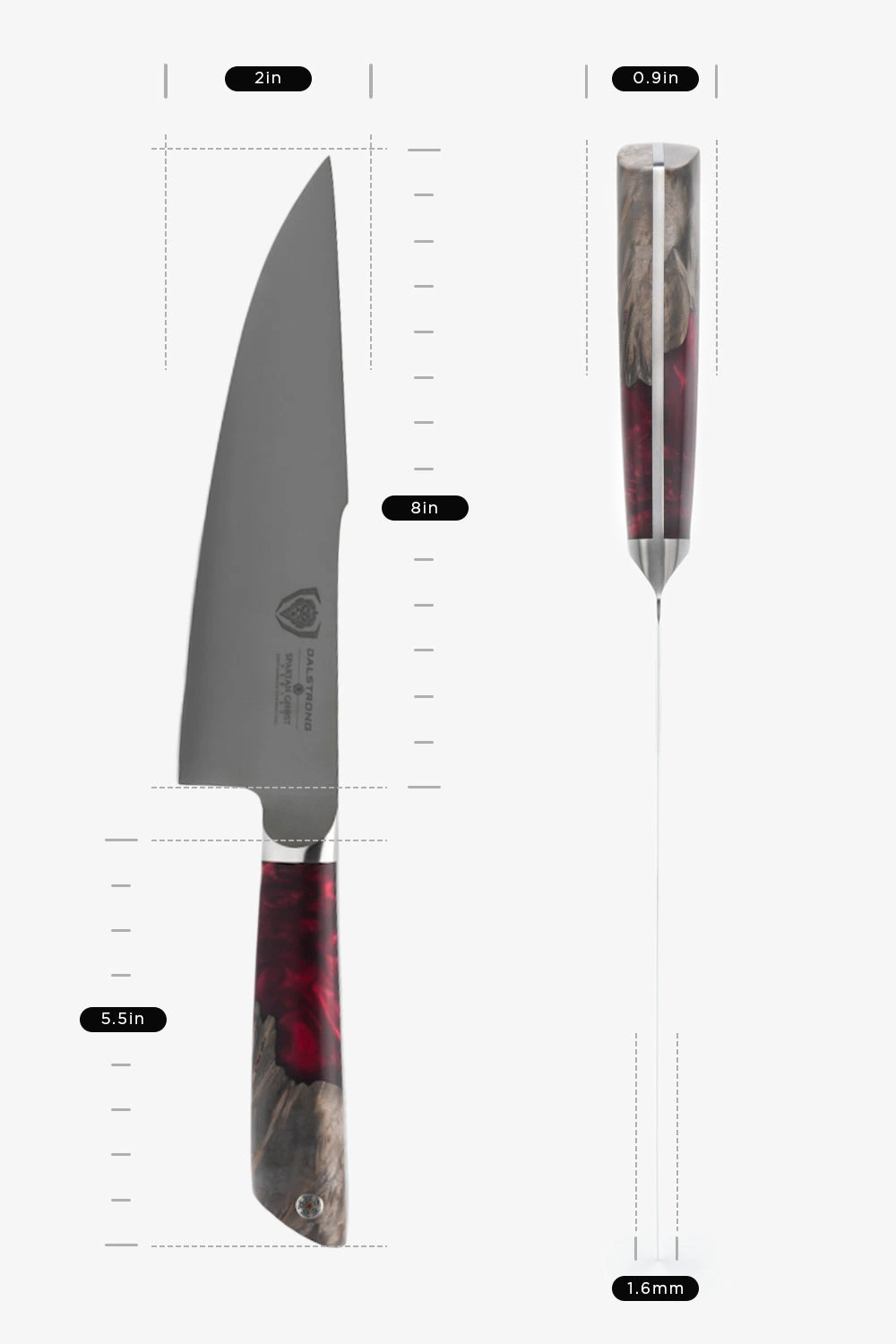
The kitchen upgrade nobody talks about is 1.6 millimeters thick
Cooks shop for sharpness. The number that decides whether food splits or slices is the one almost nobody prints.
There is a moment most cooks have had and almost nobody has words for. The knife lands on the tomato and the skin dents before it opens. Or the roast comes off the board in slices that are never quite the same twice. Or the last inch of a potato splits ahead of the blade instead of falling away from it.
The conclusion is always the same: the knife needs sharpening. Sometimes that is exactly right. Sharpening is cheap, it is fast, and it fixes a genuinely dull edge.
But sharpening only ever changes the last fraction of a millimeter of a blade. Everything behind that fraction stays exactly as it was made. And everything behind that fraction is what the food has to accommodate once the cut has started.
That part of a knife has a number too. It is just not the one anyone quotes, and on most product pages it is not printed at all. On Dalstrong's own site it appears on one knife page in ten.
01Two numbers describe a knife. Everyone quotes the first one.
The number everyone quotes is the edge angle: how narrow the wedge is at the very tip of the blade. Dalstrong prints it on its product pages. The Gladiator series is sharpened to 16 to 18 degrees. The Shogun series goes to 8 to 12 degrees. The Spartan Ghost series is ground to 9 to 11 degrees.
The number everyone quotes
Included angle of the cutting edge, drawn to scale. This is the last fraction of a millimeter of a blade, and it is the part sharpening restores.
16 to 18° Gladiator and Valhalla. Robust, easy to hone at home.
9 to 11° Spartan Ghost. Finer, and it needs more care.
Angles drawn at the midpoint of each published range. 340 of the 408 knives on the site carry a figure like this one.
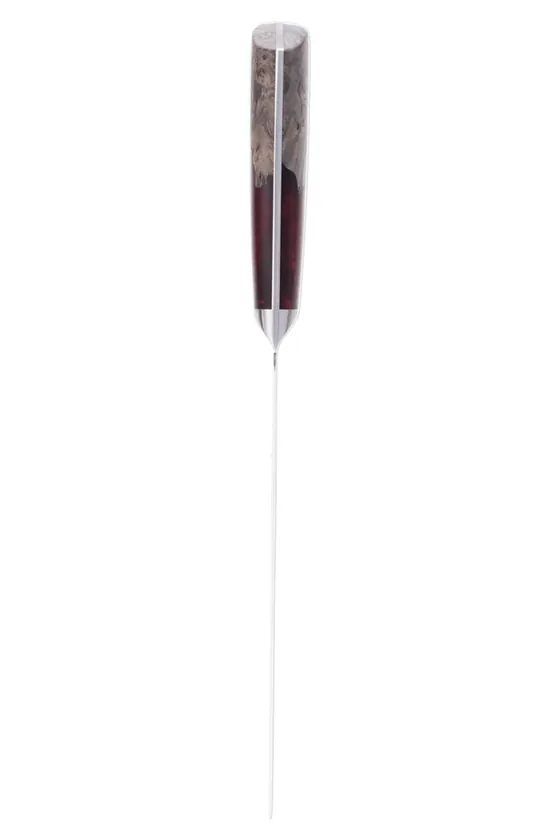
The number almost nobody quotes is the spine thickness: how thick the blade is at its back, and by extension how much steel sits behind the edge all the way up.
Here is how rarely it gets published, on Dalstrong's own site. The catalogue lists 408 knives and cleavers. 340 of them state an edge angle. 41 state a spine thickness. And across those 41 there are exactly two numbers: 2.5 millimeters, which is what the Valhalla series carries, and 1.6 millimeters, which is what the Spartan Ghost series carries. Everything else on the site tells you how sharp it is and stops there.
Counted on August 14, 2026 across the 530 items published at dalstrong.com/products.json, of which 408 are listed as knives or cleavers. Edge angle and thickness were counted as stated specification fields.
The spine, seen end on
The two thicknesses Dalstrong publishes, drawn at the same scale. The difference is 0.9 of a millimeter, which sounds like nothing until you notice it is 36 per cent of the whole.
Both figures are Dalstrong's own published specifications. Drawn at 20 times life size, both at the same scale.
Every millimeter of thickness is a millimeter the food has to move
The geometry here is not complicated, which is probably why it goes unsaid. A blade does not remove material as it travels. It parts it. To pass through a tomato, a blade 2.5 millimeters thick has to hold the two halves 2.5 millimeters apart. A blade 1.6 millimeters thick has to hold them 1.6 apart.
On something firm, that difference goes unnoticed. On something ripe, soft, layered or already cooked, it is the difference between a clean face and a crushed one, because the food has to survive being pushed aside for as long as the blade is inside it.
Dalstrong says as much in its own description of the series, and it is worth reading slowly, because it is a claim about shape rather than sharpness:
The blade is just 1.6 millimeters thick at the spine and, through a high-precision flat grind technique, carries minimal thickness behind the cutting edge. This Laser Blade Geometry is your ultimate solution for wafer-thin, delicate slices. Dalstrong, Spartan Ghost Series page, dalstrong.com
The phrase that does the work is minimal thickness behind the cutting edge. A knife can be ground to a very fine angle at the tip and still be a wedge two millimeters behind it. Sharpening will not change that. Only the grind will.
What the blade has to do to get through
Same cut, same ingredient, two thicknesses. The drawing shows displacement, not sharpness.
2.5 mm. The halves are held further apart for the whole length of the cut.
1.6 mm. Less of the ingredient has to be moved for the blade to pass.
Schematic. Thickness is drawn at the ratio Dalstrong publishes for the two series, 2.5 against 1.6.
The same sharpening process, four completely different knives
What makes Dalstrong's own catalogue useful here is that the sharpening is a constant. Every series listed below goes through the same in-house process, which the company calls D3. What changes from one series to the next is the steel, the hardness and, at the top of the range, the geometry.
| Series, 8 inch chef | Spine | Edge angle | Hardness | Blade steel |
|---|---|---|---|---|
| Gladiator Elite $79 | not published | 16 to 18° | 54 to 56 HRC | German X50CRMOV15 |
| Valhalla $159 | 2.5 mm | 16 to 18° | 58+ HRC | 9CR18MOV, 5 layer |
| Shogun Elite $179 | not published | 8 to 12° | 62+ HRC | Japanese AUS-10V, 66 layer Damascus |
| Spartan Ghost $309 | 1.6 mm | 9 to 11° | 60+ HRC edge 100+ HRC surface | American S35VN powdered |
On a phone, slide the table sideways for the hardness and steel columns. All figures as published on the product pages at dalstrong.com on August 14, 2026. Prices are the list prices shown the same day for the 8 inch chef knife of each series.
Read the last two rows together. The Shogun is the harder of the two, 62+ against 60+, and its published edge angle of 8 to 12 degrees brackets the Spartan Ghost's 9 to 11. On sharpness alone the cheaper knife would win. What separates them is that only one of the two publishes a spine, and it is the thinnest number on the site.
Hardness across the range
Rockwell hardness of the cutting edge, as published by Dalstrong for each series.
Hardness is what lets an edge stay thin without folding over. It is not the same thing as how thick the blade is behind that edge, which is why the two numbers move independently across the range.
Why a blade this thin is normally a bad idea
Thin and hard is a difficult combination. Take steel down to 1.6 millimeters and any hardness that is not backed by toughness will chip instead of flex. Dalstrong concedes the point on the same product page, in the care instructions: "Care required due to ultra-thin blade geometry and steel composition".
Dalstrong's answer is the steel itself. The Spartan Ghost blades are made from American S35VN, a powdered steel, and the company explains the process in plain terms on its own series page:
Formed by diffusing and compacting powdered metal particles, then rapidly cooling them to create a rock solid structure ... This advanced metallurgical process produces a microstructure where carbides ... are evenly distributed and densely packed. Dalstrong, Spartan Ghost Series page, dalstrong.com
Carbides are what does the cutting, and Dalstrong describes them exactly that way, as "extremely hard particles responsible for cutting power". What the powder route buys is their even spacing, which is the thing the company leads with. It also publishes the composition that goes with it: 1.4 per cent carbon, 14 per cent chromium, 3 per cent vanadium, 2 per cent molybdenum, and states the consequence directly, that the steel "grinds to an extremely thin 9 degree edge without compromising its strength".
What powdered steel changes
An illustration of the microstructure Dalstrong describes, not a micrograph.
Clustered. Large, unevenly spread carbides. A very fine edge has to be ground through the gaps between them.
Evenly distributed. The structure Dalstrong describes for S35VN, which is what lets the grind go this thin.
Schematic illustration of the description published by Dalstrong. Particle sizes and spacing are indicative.
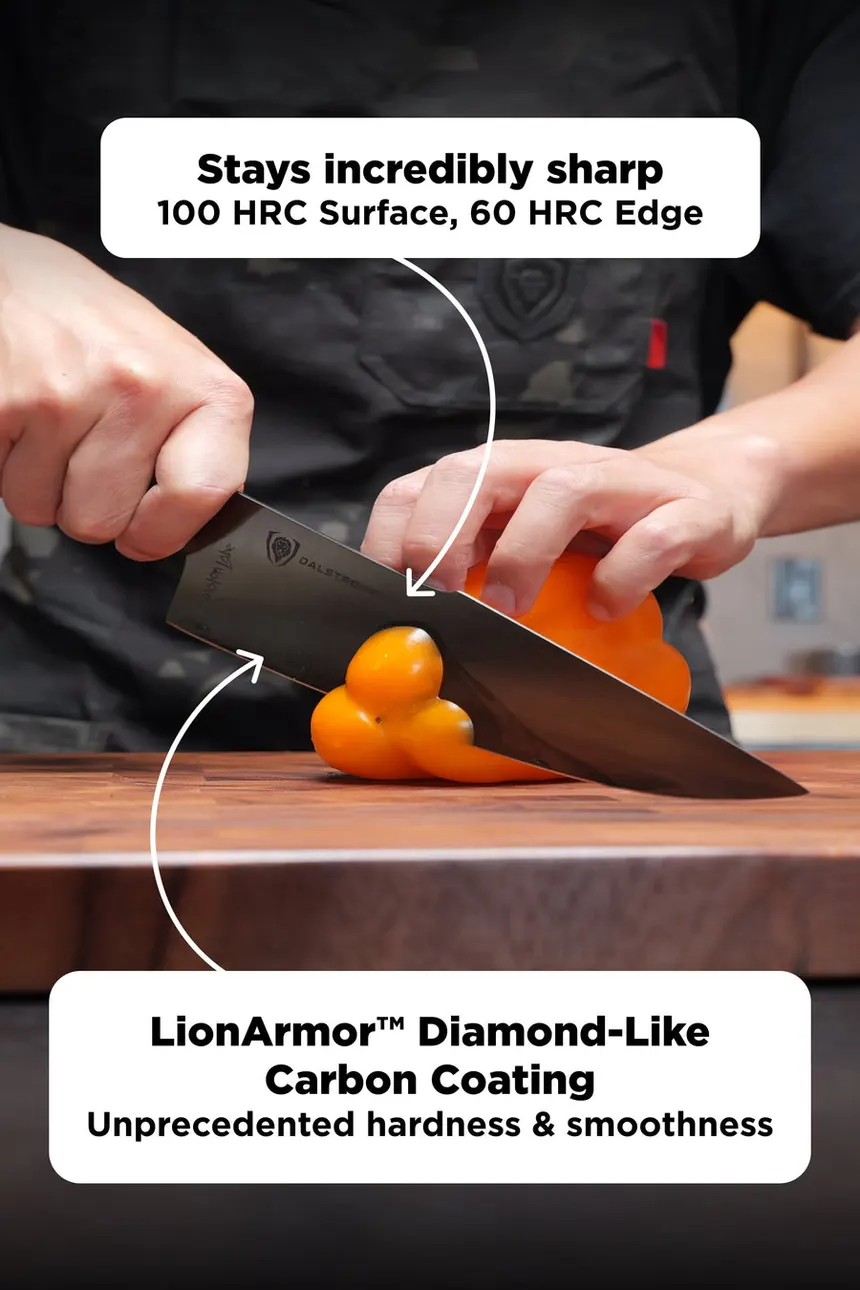
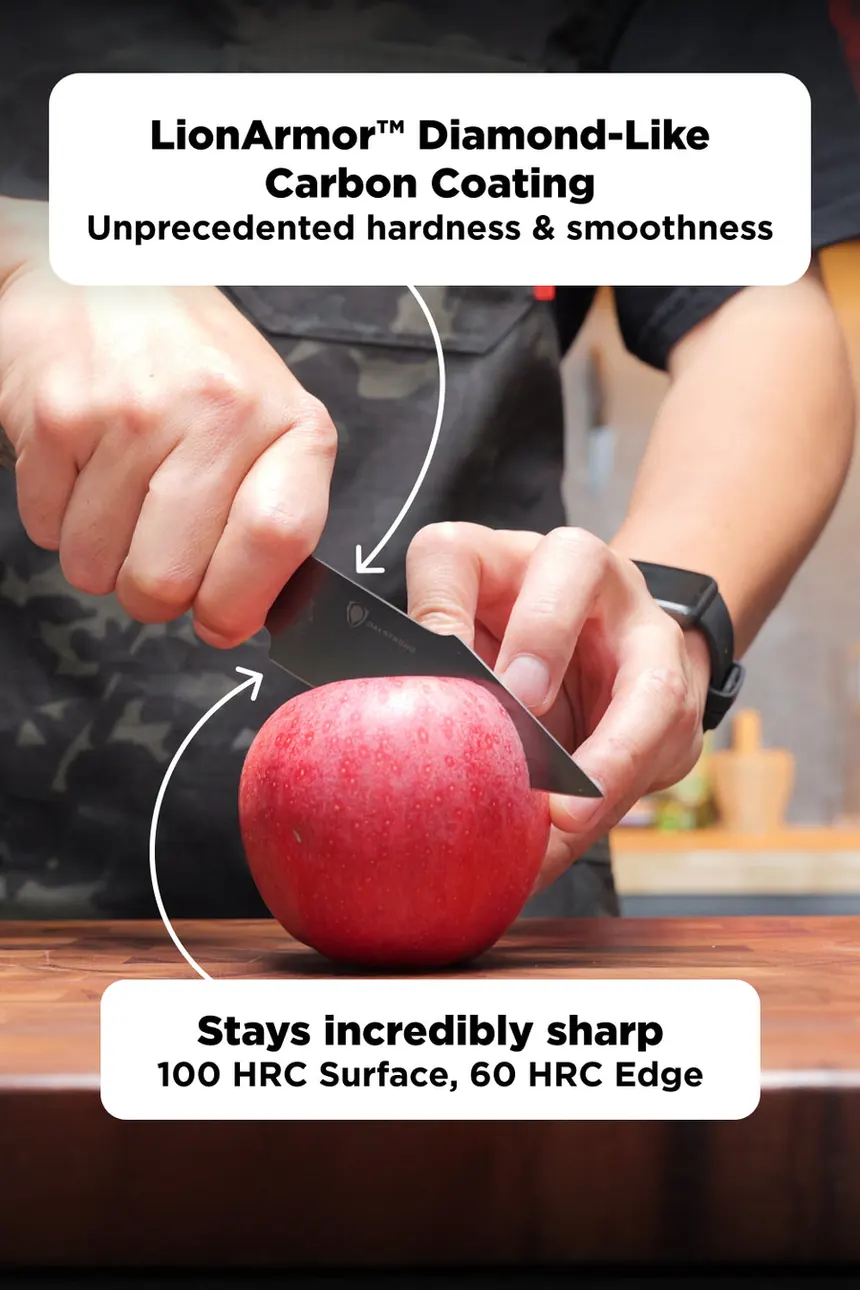
There is a second layer on top of it, and it is the part most people would assume is decoration. Dalstrong applies a diamond-like carbon coating by physical vapour deposition, which it calls LionArmor, and states its effect on the surface rather than the edge:
Applied as a Physical Vapor Deposition, LionArmor is a microns-thin layer of Diamond-Like Carbon that transforms the blade surface to an unprecedented 100+ HRC on the Rockwell Hardness Scale. Dalstrong, Spartan Ghost Series page, dalstrong.com
Surface hardness is not sharpness. It is friction. Once a blade is inside a dense ingredient, part of what a cook reads as resistance is the food gripping the flat of the blade rather than the edge failing to cut. Dalstrong's own phrase for what the coating buys is zero drag, and it is a separate lever from both the edge angle and the spine.
Three different things, one feeling
What a cook experiences as "this knife cuts well" is three separate properties of the blade, decided at three different points on it.
Only the first of the three can be changed after you buy the knife. It is also the only one most people ever look at.
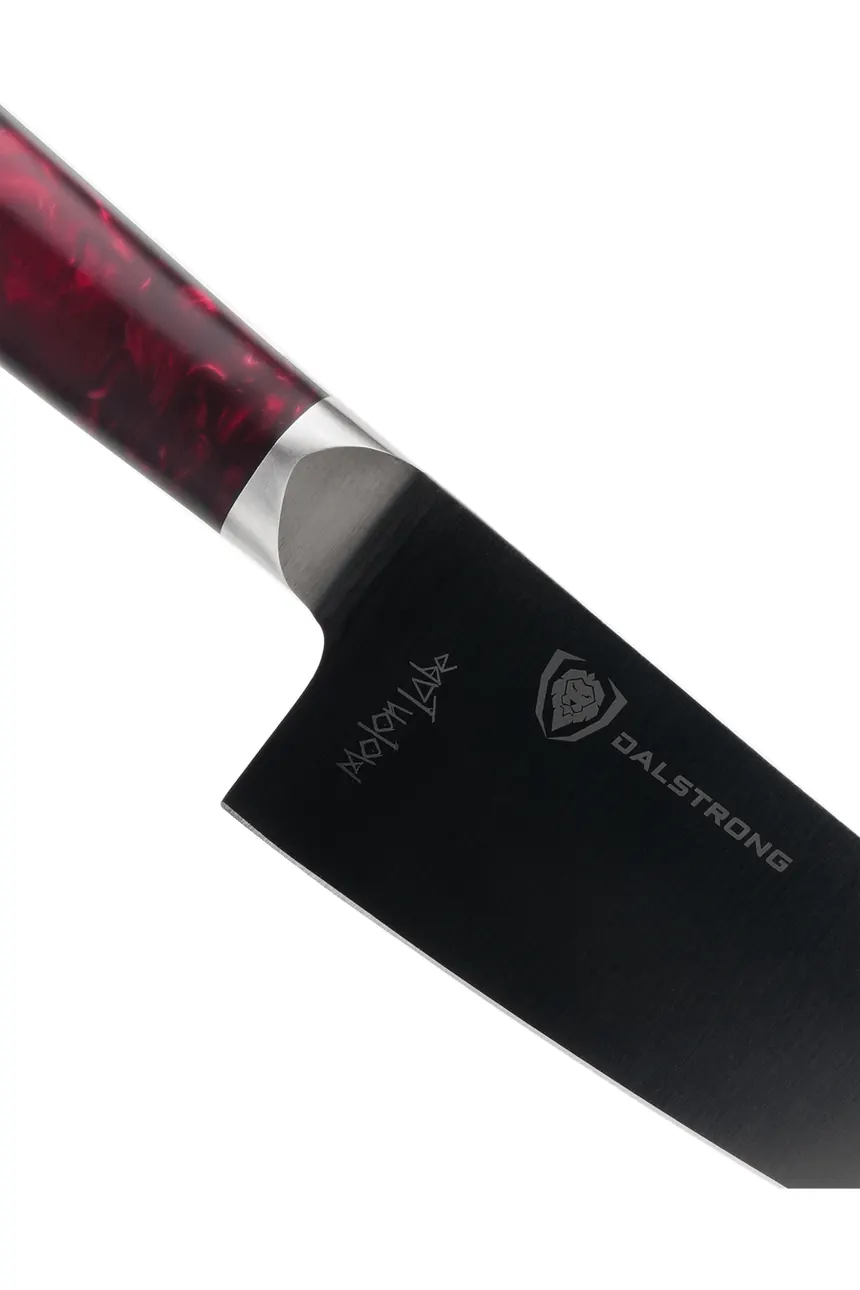
What people who own one actually report
Dalstrong publishes customer reviews on each product page. Across the five knives in the Spartan Ghost series there are 107 published reviews at the time of writing, averaging 4.94 out of 5, with 100 at five stars, 7 at four, and none at three or below.
107 reviews across the five knives
Star distribution as published on the five Spartan Ghost product pages.
Read on August 14, 2026. The paring knife accounts for 61 of the 107, which is worth knowing before choosing where to start.
What is interesting is not the score. It is that the same observation keeps coming back in different words, and it is not the word sharp.
When I first picked up the knife, I understood why it's called the Ghost. It's so light in your hand, you can't believe it's there and it slices through food like an apparition passing through walls. The balance and the beauty is spot on, too.
Clarke B. on the 9.5 inch chef knifeVerified buyer
So far, its true to the commercials. I've used it daily, and I can still slice a grape paper thin while holding it with zero resistance.
Shane O. on the 8 inch chef knifeVerified buyer
I have the 18 piece Gladiator block set, plus many other knives in the Gladiator series, which I truly love - BUT these 2 new Spartan Ghost knives are AMAZING! I LOVE to see just how thin I can slice veggies, or skillfully debone chicken.
Jennie C. on the 7 inch santokuVerified buyer
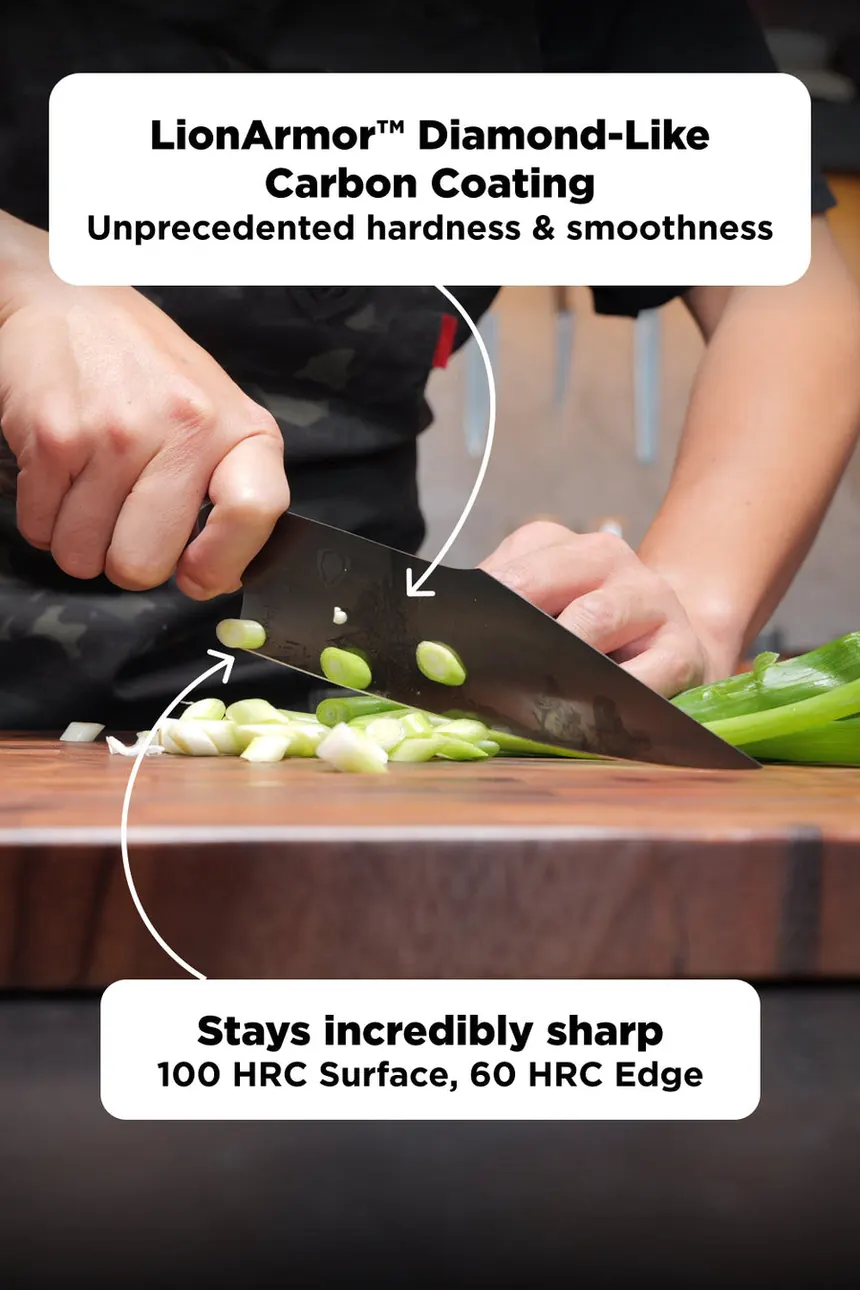
So I work at a Diner and We go through a lot of potatoes ... they can get overcooked and just fall apart as I cut they with the knives We have at work ... even the overcooked ones slice like butter due to the sharpness of the blade and My prep goes much faster now.
Stephen W. on the 4 inch paring knifeVerified buyer
That last one is the whole argument in a working kitchen, told by someone who did not set out to make it. An overcooked potato is the hardest thing in a prep list to cut cleanly, because it has almost no structure left to resist being pushed apart. It is exactly the ingredient a thick blade destroys.
All quotations above are taken verbatim from the review sections of the corresponding product pages at dalstrong.com. Spelling is the reviewers' own. Ellipses mark text removed for length.
06The chef of 46 years who was not impressed at first
The most useful review on the whole series is not a rave. It is a five star review that spends its first half being disappointed, left by a reviewer who says he has been cooking professionally for 46 years and using Dalstrong knives for five.
He describes picking the knife up and finding that it "almost felt like a cheap knife", because it was so light. He describes cutting very ripe heirloom tomatoes and watching the blade grab the skin instead of entering it. Then he honed it on a steel, a few passes, and:
It's a light saber scalpel sharp knife!! It's freakishly sharp for such a seemingly flimsy blade ... The Spartan Ghost defies all the laws and all the norms. David C., verified buyer, review of the 9.5 inch Spartan Ghost chef knife, dalstrong.com
Two things are worth taking from that. The first is that a very fine edge arrives from the factory in a state that a professional will still true up before judging it, which is ordinary and says nothing bad about the knife. The second is that geometry and sharpness are genuinely different variables, and this review accidentally separates them: the blade was thin from the first second, and it still needed its edge aligned before it behaved.
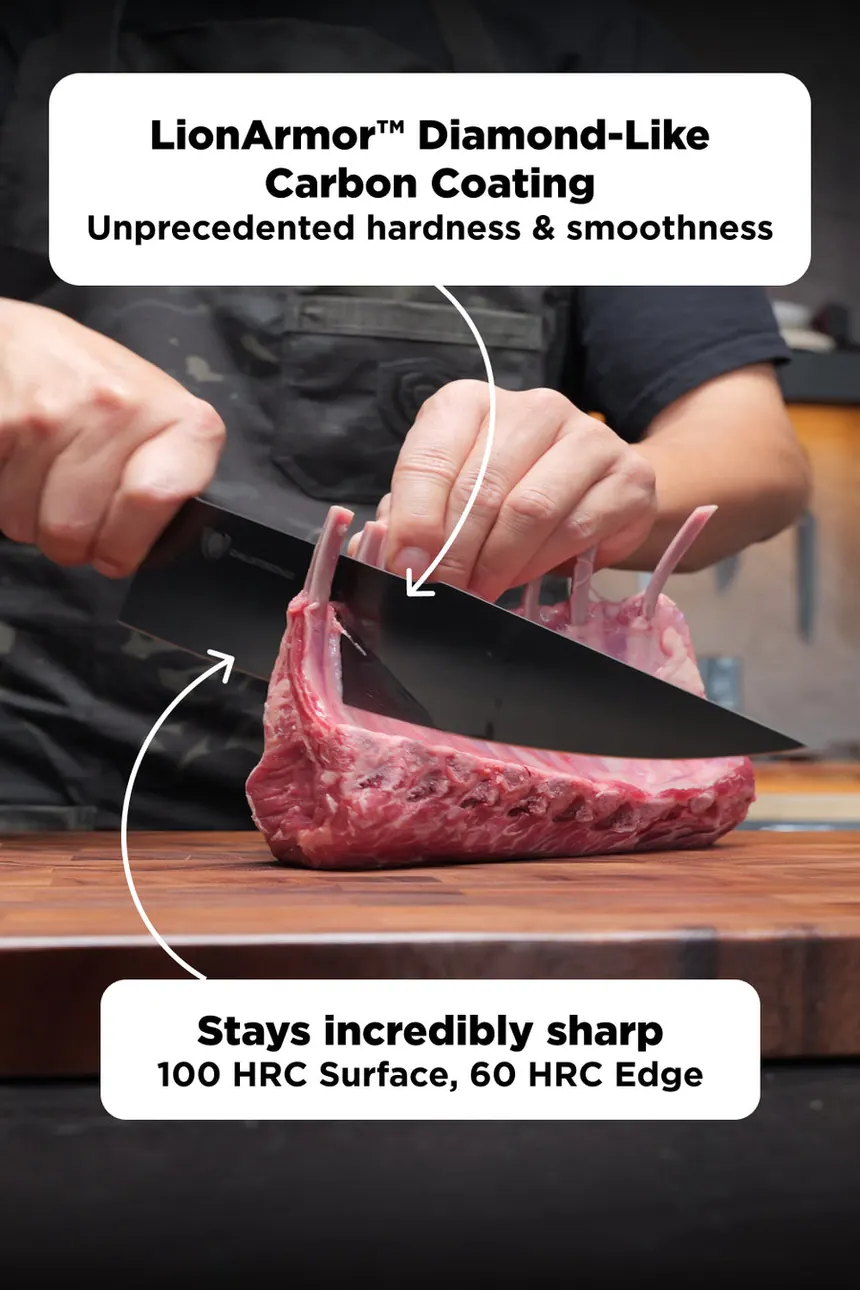
Who should not buy this knife
This is the part that usually gets left out, and it is the part Dalstrong is unusually direct about. Its own product page lists, among the use cases, the sentence "Ideal for those who prioritize cutting performance over durability", and its care instructions state plainly: "Care required due to ultra-thin blade geometry and steel composition" and "Professional sharpening advised for ultra-thin edge maintenance".
Owners say the same thing without being asked. One five star reviewer of the 8 inch chef knife writes that "the only flaw is the blade is a little to thin". Another, on the paring knife, is more specific:
Just be careful you don't cut something tough enough that it causes you to force the blade down and accidentally break it because it is a THIN knife. Definitely not suitable for bones and something like squash might be worrisome to cut. Kayson O., review of the 4 inch Spartan Ghost paring knife, dalstrong.com
Buy something else if
- You want one knife that does everything, including bones, joints and hard winter squash. Dalstrong sells that knife, in several series, and it is not this one.
- You want low maintenance. This blade is hand wash, dry immediately, hone regularly, and sharpen with more care than a 16 degree edge asks for.
- You want the most sharpness per dollar. On Dalstrong's own numbers the Shogun Elite is harder and ground finer, at $179 against $309.
The Spartan Ghost is a specialist. What it buys is the thing a thicker knife cannot buy at any sharpness, which is a cut that displaces almost nothing.
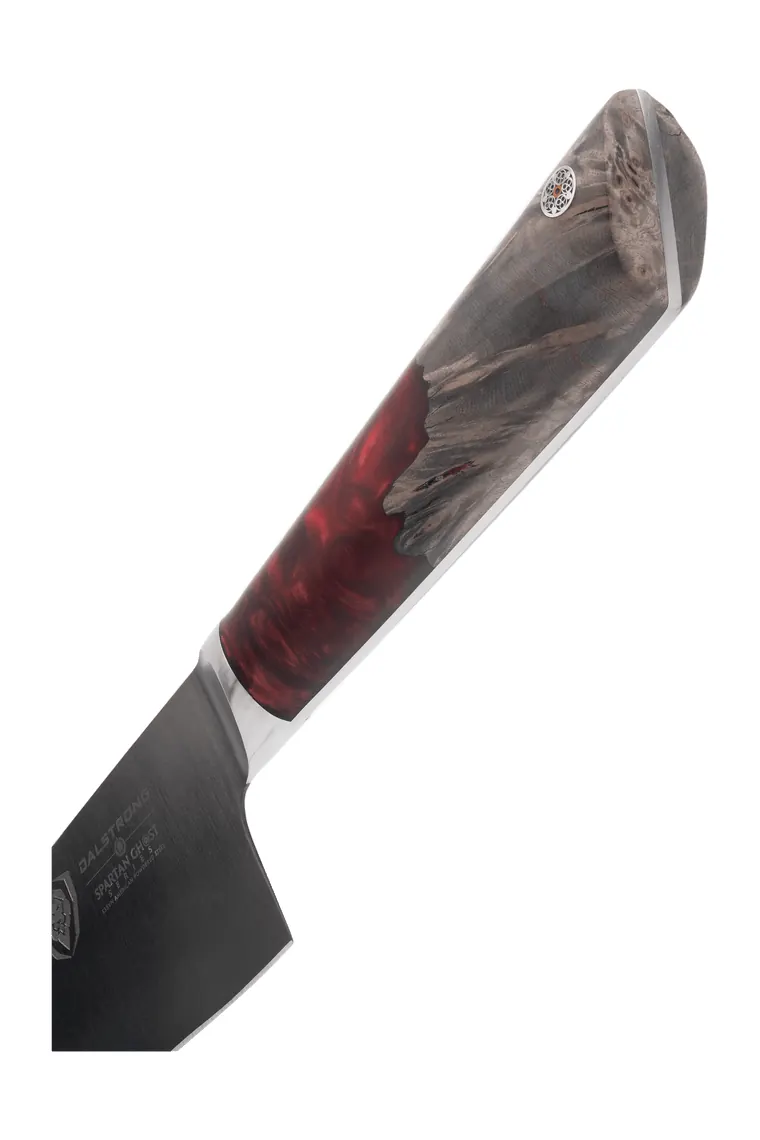
The five knives in the series
All five share the same steel, the same coating, the same 9 to 11 degree grind and the same 1.6 millimeter spine. Each comes with a genuine leather sheath, which Dalstrong lists in the materials for every model in the series.
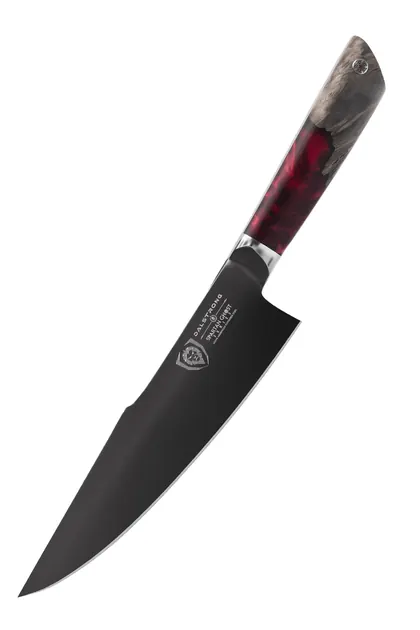 Chef's knife, 8"The one most kitchens should start with. 22 published reviews, 4.91 average.$309 · View
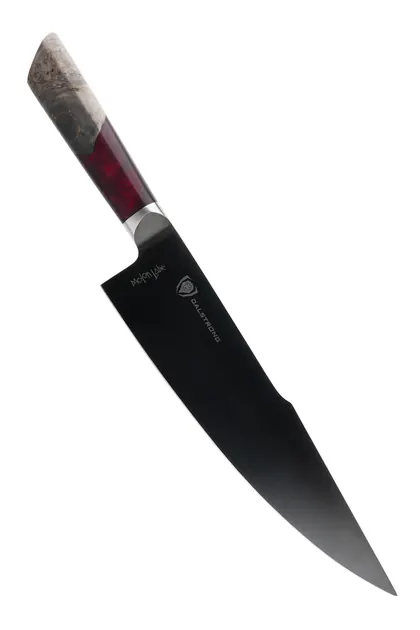 Chef's knife, 9.5"More blade for long slices through roasts and large produce. 15 reviews, 4.93.$309 · View
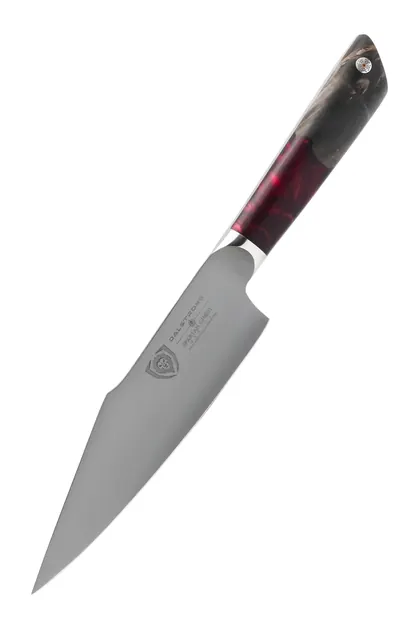 Santoku, 7"Flatter edge, shorter reach, made for downward vegetable work. 7 reviews, 4.86.$299 · View
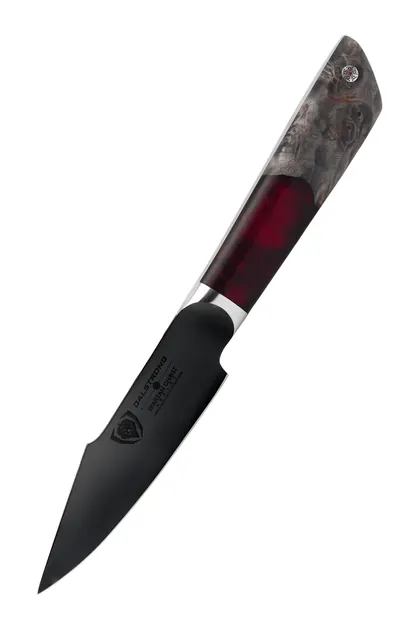 Paring knife, 4"The most reviewed knife in the series by a distance. 61 reviews, 4.95.$189 · View
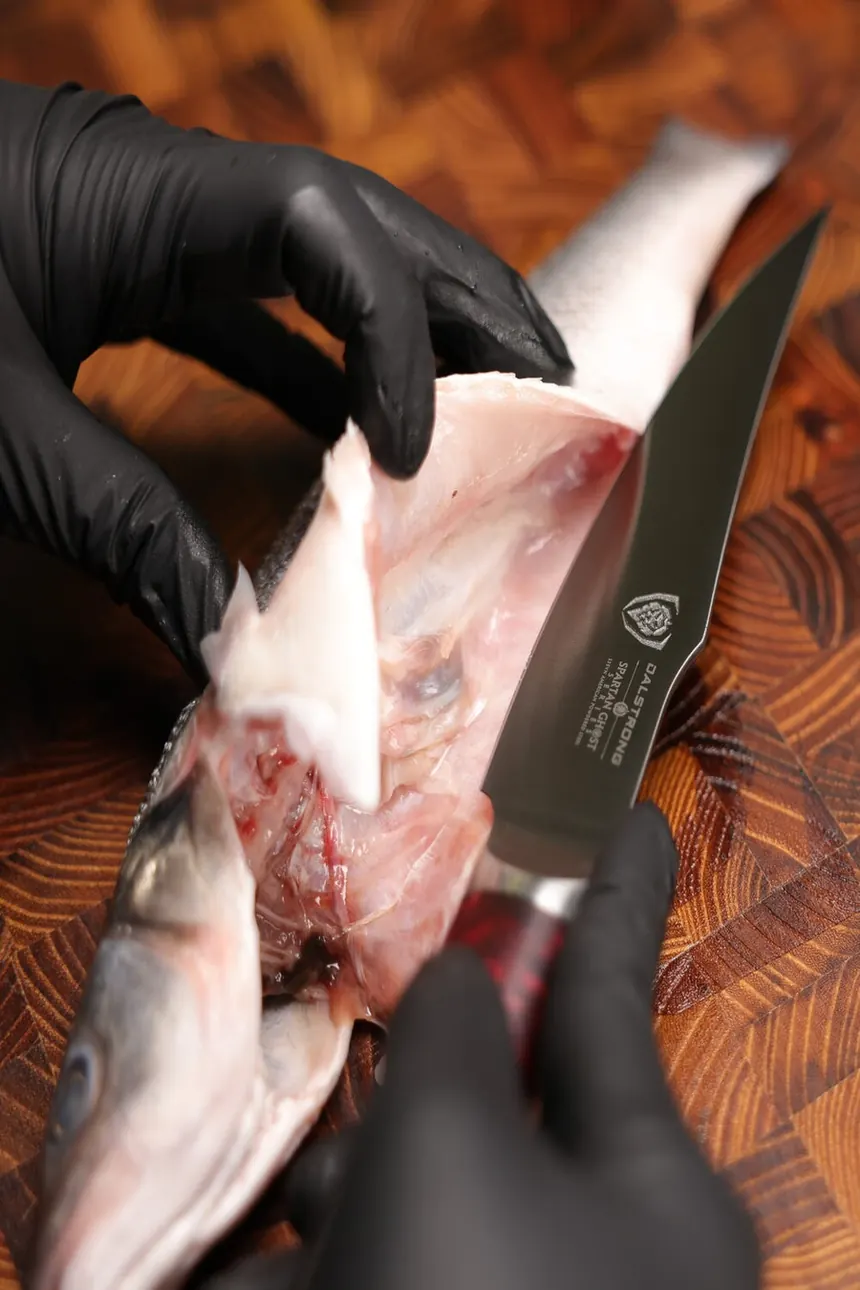
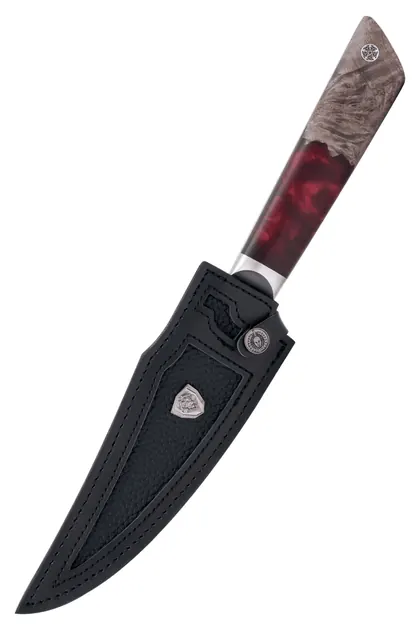 Curved fillet, 6.5"The newest of the five, for skin and bone lines on fish.$239 · View
Prices and review counts as published at dalstrong.com on August 14, 2026. The curved fillet knife is the most recent addition to the series.
What it costs to be wrong about this
Dalstrong states its terms on its own warranty page: a 70 day 100 per cent money back guarantee, and a limited lifetime warranty against defects. Standard shipping is free to qualifying US locations on orders of $150 or more, which every knife in this series clears.
Which matters more than usual here, because this is a knife whose whole argument is something you cannot evaluate from a photograph. Thickness is felt in the first ten seconds on a board, or it is not felt at all.
All four figures as published by Dalstrong for the Spartan Ghost series.
See the full Spartan Ghost series70 day money back guarantee · limited lifetime warranty · free US shipping from $150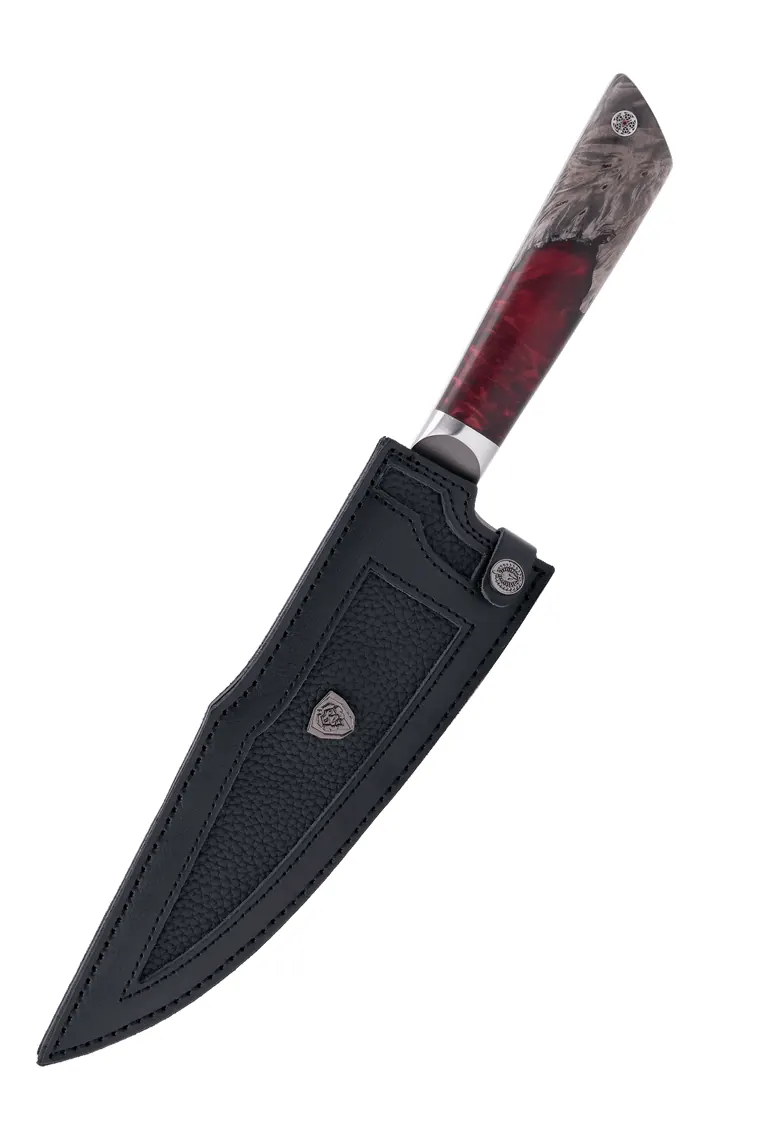
Questions people ask before buying
Can it go in the dishwasher?
No. Dalstrong's care instructions for the series are hand wash immediately after use, dry thoroughly, and store in the sheath.
How often will it need sharpening?
Dalstrong recommends regular honing to keep the edge aligned, and advises professional sharpening rather than home sharpening because of the ultra-fine angle. One owner who bought his for work writes that after two or three weeks he "still haven't had a reason to sharpen it".
Is it too fragile for normal cooking?
Owners use it daily for vegetables, fish and cooked proteins. The published limits are bones, joints and anything dense enough to make you force the blade downward. Dalstrong lists the series for delicate and precision work, not for heavy breakdown.
Which size should a home cook choose?
The 8 inch chef knife covers the majority of board work. The 9.5 inch suits larger produce and roasts. The 4 inch paring knife is the cheapest way to find out whether the geometry is worth it to you, and it is the most reviewed knife in the series.
What is actually in the box?
The knife and a genuine leather sheath, listed in the materials for every model in the series.
About this page
Nobody at Dalstrong asked for this page, and nobody there has seen it. We built it unprompted, as a demonstration, and it is yours to keep, change or have taken down.
It was assembled in a day from public material only: one of the Dalstrong ads currently running, the published specifications on your product and series pages, your own photography, your own warranty terms, and the customer reviews printed on your site. Every number on this page can be checked against a page you publish. Nothing was invented.
That is what the machine does in normal operation. One line of brief goes in, a page goes live inside 24 hours, matched to whichever ad is working that week rather than to whatever was written last quarter. The 8-figure DTC brand that runs it let both of its page developers go.
If a page a week sounds useful, the shortest version of this conversation is fifteen minutes.
Book 15 minutesIf not, that is a fine answer too. Tell us any product in the catalogue and we will build the page for that one instead, at no cost and with no expectation. This one is yours either way.
Frederic de Lavenne de ChoulotThe AI Pipe